

Cannabis retail marketing in Canada looks different than it did even a few years ago. There are now more than 3,600 licensed cannabis storefronts — dispensaries, in the term a lot of customers still search for — operating across the country, and that number keeps climbing in almost every province. For a retailer opening in 2019, standing out mostly meant being one of the few legal options in town. For a retailer opening today, it means competing with a dozen other storefronts within a short drive, plus a legacy market that never fully went away. Getting someone through the door once is no longer the hard part. Getting them to come back is.
Most cannabis retailers respond to that pressure by adding tools: an email platform here, an SMS provider there, a separate loyalty app, maybe a plug-in for the website. Each one solves a narrow problem reasonably well. Together, they create a different problem entirely.
The trouble with a marketing stack that doesn’t talk to itself
When your loyalty program, your email tool, your text platform, and your point of sale all live in different systems, someone on your team becomes the connective tissue. They’re exporting customer lists from one platform, uploading them to another, and hoping nothing changes in between.
That gap shows up in ways customers notice. A shopper who already redeemed a discount at the counter gets emailed the same offer two days later. A customer who unsubscribed from texts a month ago still gets a promo, because the unsubscribe never made it back to the sending platform. A budtender has no idea a customer is one purchase away from a loyalty tier upgrade, because that information lives in a dashboard the front counter can’t see.
None of this is any one tool’s fault. It’s what happens when the systems that hold your customer data don’t share it in real time.
What connected cannabis retail marketing looks like
The alternative isn’t fewer tools for the sake of it — it’s tools that read from the same source. This is the idea behind BLAZE Growth: loyalty, outreach, and your storefront wired directly into Greenline POS, rather than bolted on beside it. A few things change immediately:
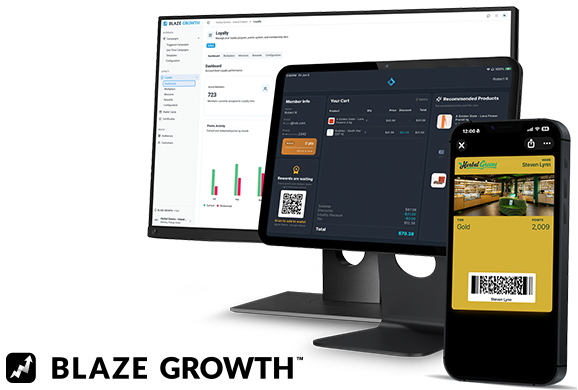
Every transaction updates a customer’s points, tier, and purchase history the moment it happens, not overnight or after a batch import. Customer segments — your regulars, your at-risk shoppers, your high-spend customers — stay accurate because they’re built from live sales data instead of a spreadsheet someone updates when they get to it. And your team works out of one dashboard instead of stitching together reports from three or four logins.
The practical upside is less about the technology and more about what it frees your staff to do: spend less time reconciling data and more time actually running campaigns.
Loyalty that rewards more than just showing up
A lot of cannabis loyalty programs still work the same simple way: spend money, earn points, redeem points later. It’s a fine starting point, but it treats every customer the same regardless of what would actually get them to visit more often.
A few structures worth layering on top of basic points:
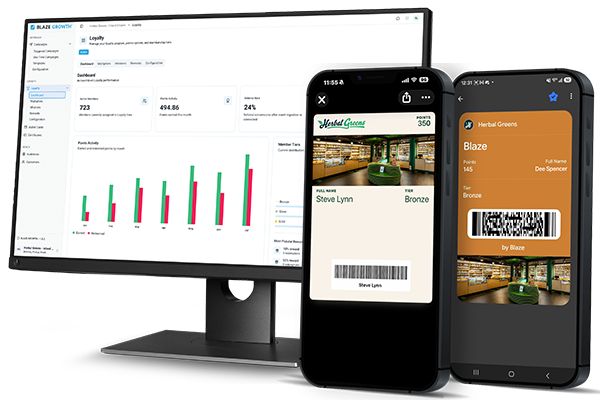
- ChallengesInstead of only rewarding total spend, reward specific behaviours — trying a new category, referring a friend, or visiting during a slower part of the week. This nudges customers toward the actions that actually grow your business, not just the ones they were going to take anyway.
- Bonus earning periodsTime-limited or category-specific bonus points create a reason to act now rather than “eventually.” A weekend where a slower-moving category earns extra points can shift real traffic without touching your regular pricing.
- Status tiersGiving your best customers a tier to move toward — with perks like early access to drops or a dedicated support line — builds a reason to stay loyal to your store specifically, not just to whichever retailer has the best price that week.
Redemption itself can stay simple: cart discounts or percentage savings, set to your own rules and branding, rather than a generic points-for-cash mechanic that looks the same at every retailer in the province.
Getting people enrolled in the first place
A loyalty program only works if people actually join it, and the biggest drop-off usually happens at sign-up, not afterward. The retailers who get the highest enrollment numbers tend to attack this from three angles at once:
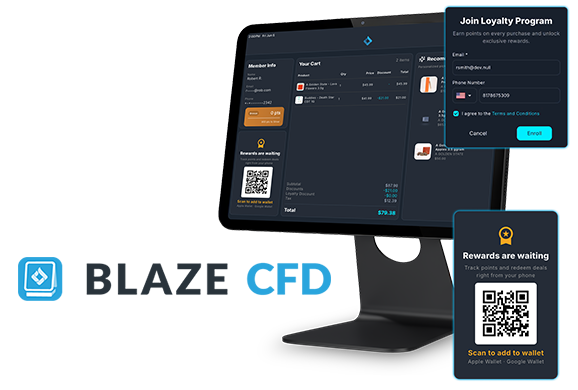
At the counter, a customer-facing display lets someone join in the time it takes to pay, without a budtender having to walk through a separate sign-up process. Online, enrollment gets built directly into the checkout flow for retailers running ecommerce or pre-order, so joining doesn’t require a second trip to a different page. And after a purchase, a short SMS or email nudge sent within a day or two of a first visit catches people while the experience is still fresh, rather than hoping they remember to sign up on a future trip.
The channels that actually bring people back
Once someone’s enrolled, the question becomes how you reach them without becoming noise they tune out. Four channels tend to carry most of the weight:
Text messages get opened at a much higher rate than almost anything else you’ll send, which makes them well suited to time-sensitive offers — but they also require clear consent up front. In Canada, that means running SMS and email under Canada’s anti-spam legislation (CASL), which is really just a matter of getting proper opt-in and making it easy to opt out; most platforms handle this automatically once it’s set up correctly.

Email is the better home for anything that needs more room — new product education, your store’s story, or a segmented offer built around what someone actually buys. Push notifications work well for retailers with their own app, giving real-time nudges to an audience that already chose to install something. And wallet notifications — delivered straight to a lock screen through Apple Wallet or Google Pay — reach people without requiring an app at all, which matters more than it might sound.
Why the wallet pass approach is worth taking seriously
Asking a customer to download a dedicated app is a bigger ask than it looks. Industry benchmarks from 2026 put average 30-day app retention at around 4%, meaning the vast majority of people who download an app stop using it within a month of getting it. For a cannabis retailer, that’s a lot of development and marketing effort spent on something most customers will delete before their next visit.
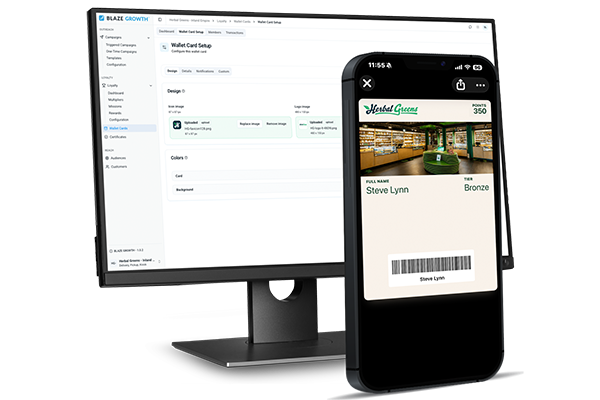
A branded loyalty card that lives in a customer’s existing Apple Wallet or Google Pay app skips that problem entirely. There’s no download, no account to create, and no update to install. The customer taps their phone at checkout to redeem a reward, and the card can also trigger a notification when they’re near the store — all without asking them to do anything they weren’t already going to do with their phone.
The bottom line for Canadian cannabis retailers
None of this requires hiring a bigger marketing team. It requires fewer disconnected pieces. A retailer running BLAZE Growth on top of the same Greenline POS data isn’t managing four vendor relationships and reconciling four sets of customer records — they’re running one system that already knows what happened at the register five minutes ago.
For Canadian cannabis retailers competing in an increasingly crowded market, that difference tends to show up less in any single flashy campaign and more in the steady, unglamorous work of getting the same customer to come back a second, third, and tenth time. That’s what cannabis retail marketing for Canadian dispensaries looks like in practice.